Inhaltsverzeichnis
Substation Design needs a Database
 f.werres
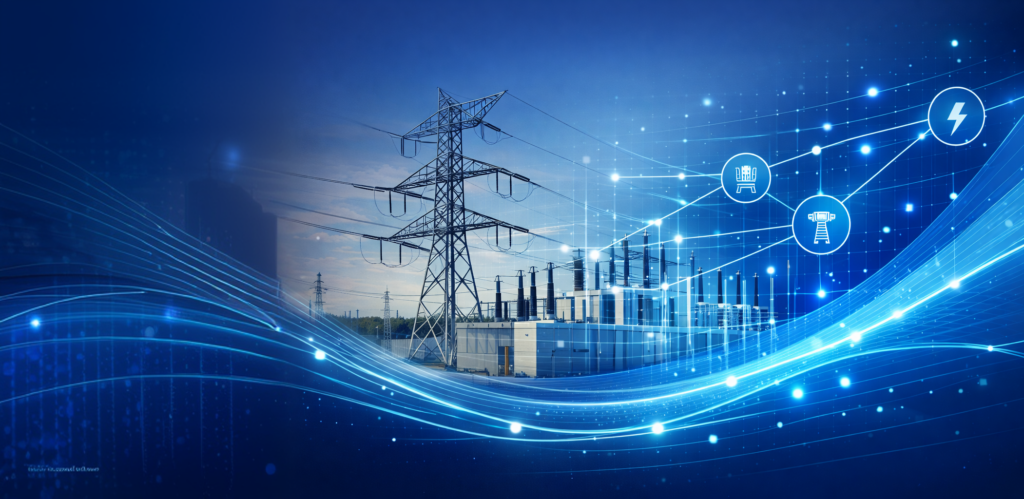
Substation engineering has traditionally been built around CAD files. Drawings, layouts, schematics, and 3D models are created, exchanged, and archived as individual files. While this approach has proven effective for document creation, it reaches its limits when engineering data needs to support the entire lifecycle of a substation.
The Issue with Files
A CAD file is essentially a data container. The boundaries of that container are often defined by the software used or by the engineer who created it.
While a file can describe a drawing, a 3D model, or even a complete engineering discipline, it cannot easily represent all relationships that exist within a real substation. Technical assets are connected in many different ways. A circuit breaker, for example, is not only a graphical object. It is also part of electrical circuits, maintenance processes, protection systems, SCADA systems, GIS systems, and asset management databases.
Files are generally not designed to manage these relationships.
Links between files exist, but especially across software vendors, they are often limited and difficult to maintain. As projects evolve, information becomes distributed across multiple files and systems, creating data silos.
Why Technical Assets Require Databases
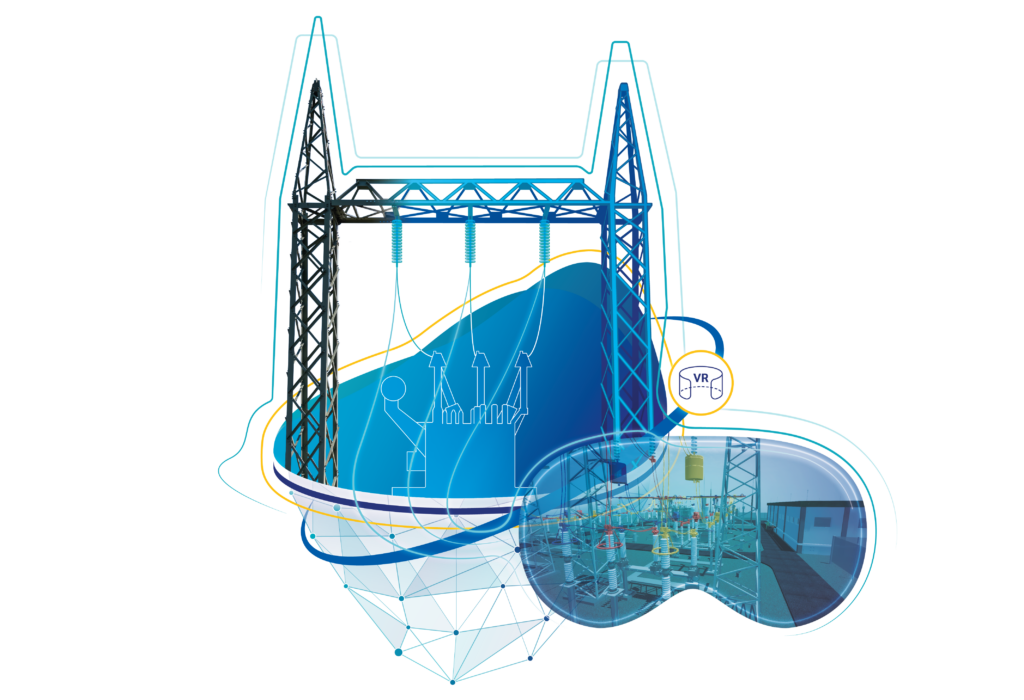
A substation is not simply a collection of documents. It is a collection of assets and relationships.
For that reason, technical infrastructure is much better represented in database systems. Databases can store not only objects, but also the relationships between objects. They can represent electrical connectivity, equipment hierarchies, geographic relationships, maintenance dependencies, and many other aspects simultaneously.
This becomes even more important when considering the wider system landscape. A modern grid operator typically uses asset management systems, SCADA systems, GIS platforms, protection systems, and engineering systems. Each of these systems has its own data model and its own view of the same physical asset.
The challenge is not to create one huge system that replaces all others. The challenge is to connect them consistently.
Taxonomy and Ontology Matter
One important advantage of database-based approaches is their ability to represent taxonomy and ontology.
A taxonomy provides a structured classification of assets. It defines what is a circuit breaker, a current transformer, a disconnector, or a busbar and ensures consistent classification across projects and systems.
An ontology goes further. It defines the relationships between assets and gives meaning to the data. An ontology can describe which assets are electrically connected, which protection functions depend on a device, or which maintenance activities are associated with a certain asset.
This kind of semantic information is very difficult to manage with files alone. Database systems, on the other hand, are specifically designed to store and query these relationships.
As a result, questions such as the following become easy to answer:
- Which assets are connected to this circuit breaker?
- Which protection functions are affected if this asset is taken out of service?
- Which neighboring assets could be impacted by a failure?
- How is this equipment represented in SCADA and GIS?
Single Source of Truth
For a digital twin, object-based links between systems are essential.
When a circuit breaker is created in the engineering environment, that object should be linked to the corresponding object in the asset management system, the SCADA environment, the GIS platform, and other relevant operational systems.
This creates a Single Source of Truth. Every system keeps its own specialized data, but all systems reference the same underlying asset. Information does not need to be duplicated and inconsistencies can be reduced significantly.
The result is a connected data landscape rather than a collection of isolated files.

Beyond Documentation
Once object relationships exist across systems, entirely new use cases become possible.
Engineering systems can provide detailed connectivity information to asset management applications. Operational systems can evaluate the impact of equipment failures or switching operations. Data from multiple sources can be combined to assess overload conditions, overcurrents, maintenance risks, or network constraints.
The same applies to visualization. A modern 3D environment can combine topology, detailed asset information, GIS context, and even operational data such as load flows. Instead of navigating through disconnected files, engineers and operators can access a much more complete view of the substation.
Conclusion
File-based systems remain extremely valuable for creating engineering documentation. Drawings, schematics, and 3D models will continue to play an important role in substation projects.
However, when the objective extends beyond documentation, files quickly reach their limits. They are not designed to represent the full network of relationships that exists between assets, systems, and operational processes.
Database-based systems are better suited for this task.
They can store assets, relationships, taxonomies, and ontologies while connecting engineering data with asset management, SCADA, GIS, and other operational systems.
For substation engineering, this is the key difference:
Files describe parts of a substation. Databases can represent the substation as a connected system.